SEO · 7 min read
What Is SEO? A Plain-English Guide for Small Businesses
What is SEO? A plain-English guide to how search engines work, plus on-page, technical and local SEO, with practical examples for small businesses.
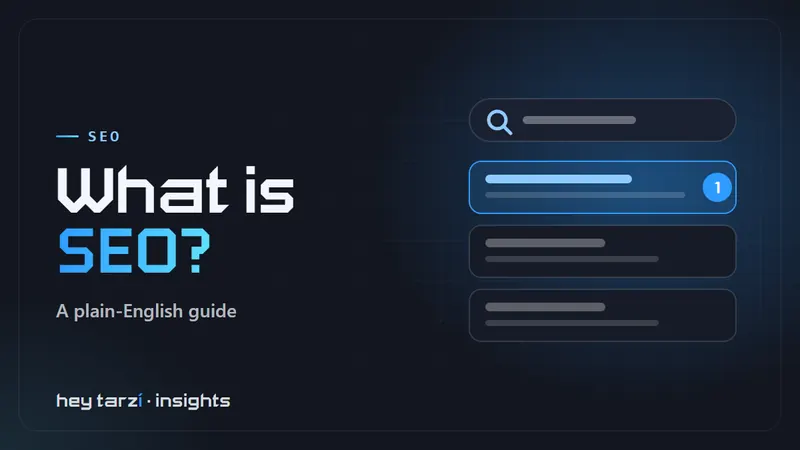
If you run a business with a website, someone has probably told you that you "need SEO". It is a short word for a broad set of jobs, and it is easy to feel lost. So, what is SEO? Search engine optimisation is the work of making your website easier for search engines like Google to find, understand and trust, so that it shows up when people search for the things you sell or do.
This guide explains how search engines work, the main types of SEO, and what you can realistically do about each one. No jargon for its own sake, and no promises of overnight results.
How search engines work
Before you can improve how a site performs in search, it helps to know what a search engine is actually doing. Broadly, there are three stages.
1. Crawling
Search engines send automated programs, often called crawlers or bots, to visit pages across the web. They follow links from one page to another and from one site to another. If nothing links to a page and it is not listed in a sitemap, a crawler may never find it.
2. Indexing
Once a page has been crawled, the search engine tries to understand it: what it is about, what kind of page it is, and whether it is worth storing. Pages that are stored go into the index, which is essentially an enormous library catalogue. A page that is not indexed cannot appear in results, no matter how good it is.
3. Ranking
When someone types a search, the engine looks through its index and decides which pages best answer that particular query. It weighs many signals, including how relevant the content is, how useful and trustworthy the page seems, how well the site works on a phone, and where the searcher is located. Nobody outside the search companies knows the exact recipe, and it changes regularly, which is why anyone guaranteeing a number one position should be treated with caution.
The main types of SEO
SEO is usually split into a few areas. They overlap, but thinking about them separately makes the work easier to plan.
On-page SEO
On-page SEO covers everything on the page itself. That includes:
- Page titles and headings that clearly say what the page is about.
- Content that answers the question a searcher actually has, in enough depth to be useful.
- Meta descriptions, the short summaries that often appear under your link in results.
- Internal links that connect related pages so both visitors and crawlers can move around.
- Images with sensible file names and alt text.
Take a local bakery. A homepage titled "Home" with a paragraph about the owner's passion for baking tells a search engine very little. A page titled "Sourdough and Celebration Cakes in Leeds", with sections on each product, opening hours and how to order, gives it plenty to work with. The bread is the same; the page is simply clearer.
Technical SEO
Technical SEO is about the foundations: whether search engines can crawl and index your site without trouble, and whether it works well for visitors. Common areas include:
- Page speed and how the site performs on mobile.
- A clean site structure, with sensible URLs.
- An XML sitemap and a robots.txt file that do not accidentally block important pages.
- Fixing broken links, redirect chains and duplicate pages.
- Structured data (schema) that helps search engines understand things like reviews, products, events or FAQs.
- Secure HTTPS across the whole site.
Technical issues are often invisible to the business owner. A site can look lovely and still have half its pages marked "do not index" because of a setting left over from development. A technical audit is the usual way to find these problems.
Local SEO
If you serve customers in a particular area, local SEO matters a great deal. When someone searches "emergency plumber near me" or "florist in Bristol", search engines try to show nearby businesses, often in a map listing above the regular results.
Local SEO tends to involve:
- A complete, accurate Google Business Profile with the right categories, hours, photos and service areas.
- Consistent business name, address and phone number across your website and directories.
- Genuine reviews from real customers, and replying to them.
- Location and service pages on your own site that are actually useful, rather than near-identical copies with the town name swapped.
A plumber who covers three towns might have one solid page per town explaining response times, the services offered there and any local details, instead of thin pages that repeat each other.
Off-page SEO
Off-page SEO is about signals from elsewhere on the web, mainly links from other sites to yours. A link from a respected local newspaper, a trade association or a supplier can act a bit like a recommendation. The key word is earned: buying links or joining link schemes breaks search engine guidelines and can do more harm than good.
AI search and answer engines
Search is no longer just ten blue links. AI-generated answers and assistants now summarise information and sometimes cite sources. The basics still apply here: clear, accurate, well-structured content from a business that is easy to verify. We cover this in more detail in our guide to getting a small business ready for AI search.
What SEO is not
A few common misunderstandings are worth clearing up.
- It is not a one-off task. Your competitors keep publishing, search engines keep updating, and your own business changes. SEO works best as ongoing upkeep.
- It is not about stuffing keywords. Repeating a phrase over and over makes pages worse to read and does not fool modern search engines.
- It is not guaranteed. Good SEO improves your chances. Anyone promising a specific ranking by a specific date cannot control the outcome.
- It is not separate from the rest of your marketing. SEO works alongside your website, your content, your reviews and your reputation. If you want the bigger picture, read what digital marketing is.
Where to start
If you are new to this, here is a sensible order of work.
- Check that your site is indexed. Set up Google Search Console and see which pages Google knows about and whether it reports any problems.
- Work out what people search for. List the services you offer and the words customers actually use. Our guide on how to do keyword research walks through this step by step.
- Give each important topic its own clear page. One page per main service is a good rule of thumb.
- Tidy up titles, headings and descriptions so each page says plainly what it offers and where.
- Sort out your Google Business Profile if you serve a local area.
- Fix obvious technical problems, starting with anything that blocks indexing or makes the site slow on phones.
- Keep going. Add useful content, ask happy customers for reviews, and review progress every month.
Once the basics are in place, the next question is usually how to climb higher in results. That is what our guide on how to rank on Google covers.
How we approach SEO at Tarzi
Our SEO service is built around the same areas described above: a technical audit, a keyword and intent map, on-page work, local SEO, AI search optimisation and plain monthly reporting so you can see what was done and what changed. If you are wondering what that kind of support usually involves financially, our article on how much SEO costs explains the common pricing models.
If you would like a second opinion on your own site, talk to us about SEO and we will tell you honestly where we think the biggest gains are.
Frequently asked questions
What is SEO in simple terms?
SEO, or search engine optimisation, is the work of making your website easier for search engines to find, understand and trust, so it can appear when people search for what you offer.
How long does SEO take to work?
It depends on your site, your competition and how much work is needed. Most businesses should think in months rather than weeks, and treat SEO as ongoing rather than a one-off job.
Can I do SEO myself?
Yes, many basics are within reach of a business owner, such as writing clear page titles, describing your services properly and keeping your Google Business Profile up to date. Technical problems and competitive markets are where outside help tends to pay off.
Is SEO different from paid search ads?
Yes. Paid ads appear because you pay for each click or impression, and they stop when you stop paying. SEO aims to earn unpaid listings that keep bringing visitors without a per-click cost.