Marketing · 6 min read
How to Get More Leads: A Practical Guide for Small Businesses
Learn how to get more leads online with clear offers, focused landing pages, search, follow-up and simple tracking. Practical steps for small businesses.
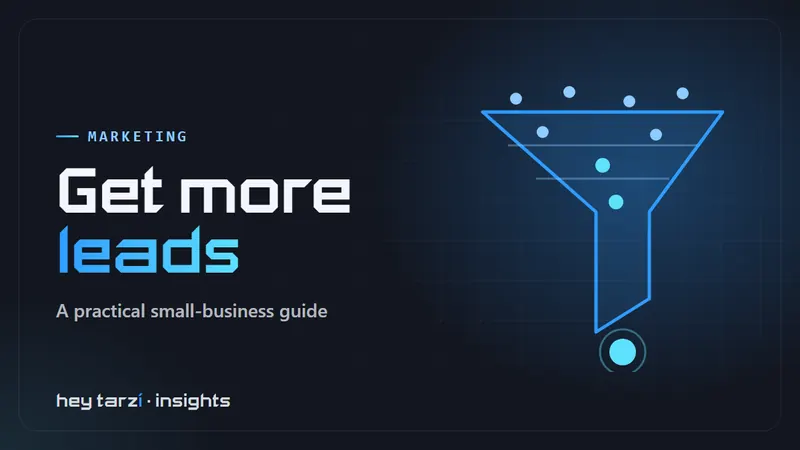
Most small businesses do not have a traffic problem as much as a leak problem. People visit, look around and leave without getting in touch. Before spending more on ads, it is worth fixing the leaks. This guide covers how to get more leads in a practical order: start with the offer, then the page, then the traffic, then the follow-up. Each step makes the next one work harder.
What counts as a lead?
A lead is someone who has shown interest and given you a way to reach them: a filled-in form, a phone call, a WhatsApp message, a booking request or an email sign-up. Decide what a good lead looks like for you before you start. "Twenty enquiries a month" means little if half of them are outside your area or want a service you do not offer.
Write down:
- who your ideal customer is;
- what they usually ask for first;
- what action you want them to take (call, book, request a quote).
Everything below builds on that.
Step 1: Make an offer worth responding to
"Contact us" is not an offer. People respond to something specific that helps them decide.
Compare these:
- "Get in touch for more information."
- "Book a free 15-minute call and we will tell you whether your website needs fixing or rebuilding."
The second tells the visitor exactly what happens next and what they get. Good offers are usually one of:
- A consultation or audit: a short call, a site check, a quote within a set time.
- A useful resource: a checklist, a price guide, a template.
- A low-commitment trial: a sample, a first session, a small starter project.
Pick one main offer per audience. Too many choices on one page often means none gets chosen.
Step 2: Build landing pages that do one job
A homepage tries to speak to everyone. A landing page speaks to one person about one thing. If you are running ads or sharing a link for a particular service, send people to a page built for it.
What a focused landing page includes
- A headline that names the problem or result. "Get more bookings for your clinic", not "Welcome to our website".
- A short explanation of what you do and for whom.
- Proof, using only what you can genuinely show: real client names (with permission), real examples of work, accurate details.
- The offer and one clear action, repeated near the top and bottom.
- A short form. Ask only for what you need to reply. Every extra field is another reason to leave.
- Answers to the obvious worries: price range or how pricing works, timelines, what happens after they enquire.
Technical basics that cost leads when ignored
- The page loads quickly on a phone.
- The form actually works, and someone receives the notification. Test it monthly.
- Your phone number is tappable on mobile.
- The page is readable without zooming.
If your site makes any of these hard, it may be time to look at web development rather than another round of ads.
Step 3: Get found by people already searching
The warmest leads are people already looking for what you offer. That is why search matters.
Search engine optimisation
SEO means making your pages easy for search engines to understand and worth ranking. For lead generation, focus on:
- Service pages for each thing you sell, written in the words customers use.
- Location pages if you serve specific areas, with genuinely useful local detail rather than copied text.
- Answers to common questions, the ones you hear on every sales call.
- A complete, accurate business profile on the map and listing services your customers use.
SEO takes time to build, so pair it with faster channels while it grows. Our guide on how to rank on Google goes through the fundamentals step by step.
Paid search and social
Ads can bring traffic quickly, but they amplify whatever your page already does. A weak page with ads becomes an expensive weak page. Fix steps 1 and 2 first, then start small, measure leads rather than clicks, and only scale what works.
Step 4: Use the channels your customers already use
Different businesses get leads from different places. A few that are often underused:
- Messaging apps. Many customers prefer a quick message to a form. Make it easy to start a chat.
- Email. A simple, regular update to past enquiries and customers can bring work back.
- Short video. A one-minute clip explaining a common problem builds trust before someone ever contacts you.
- Referrals. Ask happy customers directly. Most people are glad to help but will not think of it unless asked.
- Partnerships. Businesses that serve the same customers without competing with you can send work both ways.
You do not need all of these. Choose two or three that fit how your customers behave, and do them consistently. If you want to see how these fit together, our explainer on what digital marketing is gives the bigger picture.
Step 5: Follow up quickly and properly
This is where many businesses lose leads they already paid for. Someone enquires, and the reply comes two days later, or not at all.
A simple follow-up routine
- Reply the same day where you can, even just to confirm you received it and say when you will respond fully.
- Answer the actual question. Then suggest one clear next step.
- Follow up once or twice if you do not hear back. People get busy; a polite nudge is normal.
- Log every lead, with where it came from and what happened, even in a basic spreadsheet.
If follow-up keeps slipping, it is a good candidate for automation: instant acknowledgements, reminders and lead logging can run without someone remembering. Our post on five tasks to automate first and our AI automation service cover this in more detail.
Step 6: Measure what matters
You cannot improve what you do not measure, but you also do not need a complicated dashboard. Track these each month:
| Measure | Why it matters |
|---|---|
| Leads by source | Shows which channels deserve more effort |
| Leads that became customers | Separates good leads from noise |
| Time to first reply | Often the simplest thing to improve |
| Landing page visits to enquiries | Tells you whether the page or the traffic is the problem |
Look for patterns rather than single good or bad weeks. If one channel brings fewer leads but more customers, it may deserve more attention than the noisy one.
A 30-day starting plan
If this feels like a lot, start here:
- Week 1: Define your ideal lead and write one clear offer.
- Week 2: Build or tidy one landing page around that offer. Test the form on your phone.
- Week 3: Improve one or two key service pages for search and complete your business profile.
- Week 4: Set up a simple follow-up routine and a lead log. Review what came in.
Then repeat, improving the weakest step each month. Steady, boring improvements usually beat one big campaign.
Want help getting more leads?
If you would like someone to look at your offer, pages and follow-up with you, our digital marketing team can help you find the leaks and fix them. Get in touch and tell us what you are working on.
Frequently asked questions
What is the fastest way to get more leads?
Usually it is fixing what you already have: a clearer offer, a focused landing page and quick follow-up. Those changes help every visitor you already get, before you spend more on traffic.
Do I need a landing page to generate leads?
You do not strictly need one, but a page built around one offer and one action usually converts better than sending people to a general homepage.
How quickly should I follow up with a new lead?
As soon as you reasonably can, ideally the same day. People enquire with several businesses, and the one that replies clearly and promptly often wins.
Is SEO worth it for lead generation?
For most businesses, yes, because search brings people who are already looking for what you offer. It takes time to build, so it works best alongside faster channels.